
Cleveland County Busted Mugshots
Custody in Cleveland County begins the moment an agency books someone into the jail system. That happens at the F. Dewayne Beggs Detention Center in Norman. The Sheriff's Office runs it. A city officer, a deputy, or a transport from another agency can all put a name into the booking system. So can a warrant pickup. Whatever the path, the record captures what officials knew when the person entered custody.
The public roster has a narrow job. It can show a booking photo while someone sits in current custody. Names vanish from the list for many reasons, though. Release, transfer, a citation instead of jail, or a booking in another county all explain a missing entry. So does a juvenile exclusion. Treat any image you find as a booking photograph from one moment, not a label about who the person is today.
A few terms come up over and over. "Booking" is the jail's intake record. "Arraignment" is an early court appearance on a charge. "Bond" is the dollar amount or the conditions tied to release. A "disposition" is simply the court's recorded outcome. And "expungement" is a legal process that can seal records when state law's requirements are met.
Cleveland County Booking Record Fields
The live roster stays lean. Its columns cover a mugshot, a name, date of birth, and arrest date. You can search by name or filter for current custody. Oklahoma public-record law sketches a much wider set of material that can be requested, with redactions applied depending on the record. Here's the catch worth remembering: a field named in a policy is no promise it appears online for every person.
| Field or record | What it can establish |
|---|---|
| Mugshot | A booking image in the public current-custody roster when one is shown. |
| Name and date of birth | Identifiers to compare carefully, especially where names are shared. |
| Arrest date | The date exposed by the public roster, useful for separating possible matches. |
| Booking or daily-jail log | An existing record that may contain booking and arrest facts, holds, charges, and bail where releasable. |
| Arresting-agency report | The city or sheriff record that can supply event details not exposed in the jail interface. |
| Court docket | Later filing, hearing, and disposition history, rather than a substitute booking photo. |
Public-record policy speaks in broad vocabulary. Physical description, arrest and booking dates, and the arrest location all count as public material, within legal limits. So do factual circumstances, charges or holds, and bail amounts. That doesn't mean a portal displays every item. It also doesn't mean a requester gets protected information. Minors, certain victims, medical details, informants, and parts of active investigations can all be withheld.
Does a roster entry prove someone is still in jail? No. It takes the record's current status plus a careful name match to answer that. An old arrest entry, a city report, or a dated booking photo cannot tell you where a person is right now.
Cleveland County Busted Mugshot Law
Start with 51 O.S. §24A.8(A), Oklahoma's baseline for law-enforcement records. It covers arrestee descriptions, arrest facts, warrant dispositions, and jail-register or booking information. The official 2012 OK AG 22 opinion treats booking photos as physical descriptions and generally open records. The same opinion acknowledges privacy and false-light concerns on specific facts, and any release still calls for accuracy, context, and required redactions.
Oklahoma has no statewide booking-photo-removal right on the books. SB 379 was introduced in 2025 and sent to the Judiciary committee, but it never became law. So it offers no enforceable removal process. Nor does the public-record rule force a sheriff to keep released people on a web roster or to generate reports that were never maintained.
Spotting a factual error? Go to the record custodian first. Bring the exact record or page, your full name, the date, identity documents, and official paperwork showing the mistake. For a sealed, expunged, dismissed, acquitted, duplicate, or wrong-person entry on a private site, use that publisher's own free correction channel. RecentlyBooked's removal policy lists its free review categories and required documentation, while Busted Newspaper's Remove a Listing path explains how to reach their correction contact. Mugshots.com and America's Top Mugshots publish similar voluntary review notices. None of these processes can alter a government record or a court outcome.
The OSBI expungement information draws a key line. A Section 18 expungement can seal a qualifying arrest record in full, while a Section 991(c) order merely updates a deferred-sentence disposition and leaves the arrest record intact. Court expungement itself is free, per OSBI, though its arrest-record processing fee runs $150 and local fees may stack on top. Nothing is preapproved, so the current OSBI page and qualified counsel should steer any individual case.
Even after a source gets fixed or deleted, an old result can linger in search. The fix is the engine's own outdated-content tool. Submit the exact URL and request a refresh of the stale page. Know the limits, though. An index refresh is not a court order. It seals nothing, and a result can persist while its source stays live.
Cleveland County Records Request Fees
When the roster lacks a field or photo you need, skip the portals. Ask the custodian directly. The CCSO Records Office handles both patrol and detention records. For an Oklahoma Open Records Act request, CCSO lists ccsorecords@clevelandcountyok.com. Request what already exists, such as a booking sheet, a daily jail log, or charge and hold details. An electronic booking photo counts too. Asking the agency to build a new historical report will get you nowhere.
Cleveland County Sheriff's Records
2600 W. Franklin Road
Norman, OK 73069-8012
405-701-8888 or 405-701-8800
Monday-Friday, 8 a.m.-5 p.m., except listed holidays
Give the custodian everything useful up front. That means a full name and a date of birth if you have it. Add the booking or arrest date with an approximate time, plus the arresting agency. Include any case or booking number attached to the matter. Spell out exactly which records you want. Ask that any withheld or redacted portion be identified along with the statute the office is relying on. Requests under the Oklahoma Open Records Act, 51 O.S. §§24A.1 through 24A.33, can cite those provisions directly.
- Identify the person and date range carefully, using a case or booking number when available.
- Specify the existing record, such as a booking sheet, jail log, electronically maintained photo, or retention schedule.
- Ask for an electronic copy if that format is wanted and request the basis for any redaction or denial.
- Confirm the current quote, delivery method, and destination before sending payment.
The sheriff's office posts its pricing on a CCSO fee schedule. Copies run $5 per report. Want it mailed, faxed, or emailed? That adds $3. A non-automated search of archived files costs $10 per half hour, and photo, audio, and video media carry separate charges. Documents sent by mail, fax, or email are ordinarily processed within 72 hours after payment, according to the schedule. Treat those numbers as a starting point. The authorization date and address on that page lag behind the current Records page, so confirm amounts before relying on them.
For the office's current contact details, use the official CCSO Records page. That page shows the route the county handles records requests through today.
A photo missing from public view does not settle whether an electronic image exists somewhere in the system. It simply means the question is still open. Ask CCSO directly for the specific retained record. For an older matter, request the retention or disposition schedule that applies.
Find Cleveland County Busted Mugshots
Start with current county custody. Then work outward. The arresting agency, the court, and the later custody system each answer a different question, so move to the next channel only when it fits what you are asking. Search with more than a bare name whenever you can. Someone absent from one channel may have been released, cited and released, moved into another system, or blocked by a restriction. What the Cleveland County process looks like depends on the date, the arresting agency, and whether you want a current jail stay, an older booking, or a court case.
- Open the official CCSO inmate-search entry and search the current roster by name with the available custody control.
- Compare the name, date of birth, and arrest date before relying on a result or its booking image.
- For a Norman event, check the dated Norman Police arrest summary and its listed destination, then check county custody when appropriate.
- Use CCSO Records for a date-limited jail log or retained booking material not visible online.
- Use OSCN and the Court Clerk for the case and disposition. Move to ODOC, BOP, or ICE only when the custody system fits.
What if there is no result? An empty roster is not proof of no arrest. It can reflect a release, a transfer, a citation, a booking outside the county, a juvenile exclusion, a sealed or restricted record, an outage, or the portal's current-inmate scope. Follow the date and the agency instead of assuming nothing ever existed.
Cleveland County Busted Jail Roster
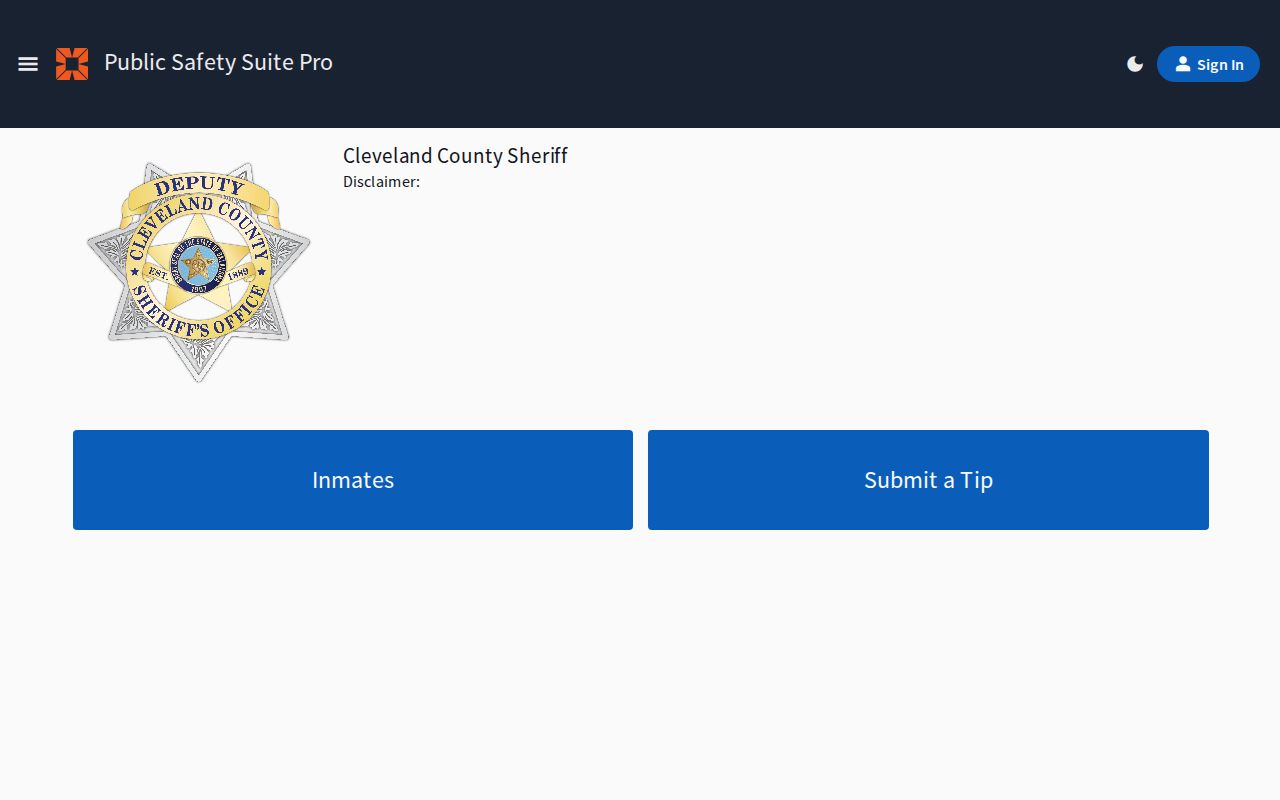
The official CCSO Inmate Search now redirects to the current CentralSquare interface. Its visible setup allows name and in-custody filters, with columns for the mugshot, name, date of birth, and arrest date. The tool describes a limit to current or today's inmates and states plainly that juveniles are not shown. Where the configuration permits, hold reasons can appear too. Treat it as a current-custody tool rather than a promised archive of every Cleveland County booking.
| Roster control or column | Use | Limit |
|---|---|---|
| Name | Start with a full or distinctive name. | A name alone can match more than one person. |
| In custody | Narrows the current jail view where available. | Does not preserve a released-person history. |
| Date of birth | Helps compare possible matches. | Only use it with the other record details. |
| Arrest date | Separates dates of custody events. | It is not a final court-charge history. |
| Mugshot | Displays a booking image when publicly shown. | No photo is promised for every intake. |
The current CentralSquare roster is where the actual public interface lives. Use it as a records tool on its own terms. Copying images into a separate gallery is not part of what it offers.
No public policy promises a set posting time after booking. Nor does it promise minute-by-minute updates, historical persistence, or a visible photo for every record. A person dropping off the roster can mean release, transfer, aging out of the current view, a correction, a restriction, or a system change. It does not prove expungement or destruction. When an image is missing or old, circle back to the records-request route.
Cleveland County Roster Link Change
Older links to Cleveland County bookings may still point at a Zuercher address. That page now shows only maintenance. The official CCSO inmate-search page routes everyone to CentralSquare instead. A saved link that fails just signals a platform switch. It does not mean someone left custody, and it does not mean no booking record exists. Start at the agency-controlled CCSO entry point rather than treating the dead portal as an answer.
This matters when an old news story, a bookmark, or a search result still names the prior system. The current roster's narrow visible fields and its current-inmate limit remain the governing public interface. If the new portal cannot settle the question, the practical fallbacks are a records request, the arresting agency's report, and the court docket.
Note: Write down the date and time you check an official portal, since custody data and public interface settings can change without any published posting schedule.
Cleveland County Busted City Reports
County custody and city arrest reporting run on different clocks. Norman Police Department Activity Reports put out dated daily arrest summaries. The Cleveland County roster, by contrast, is built around people currently in custody. A Norman report can stay online long after a county release. It can even describe an arrest that never hits the county roster at all. It is an arrest log, not a booking-photo gallery.
Each Norman daily summary can list the arrest date and time, case number, location, offense, arrestee, birthday, address, status, and officer. A status like FDBDC (Jail) is a destination marker. Treat it as a prompt to check the county roster, not proof custody continued. Norman keeps daily reports online for one month, then sends historical requests to its Records Division. The Friday weekly overview and the monthly overview opening each month's first week are summaries, not a jail archive.
Moore and Noble have no verified official daily arrest or mugshot feeds. Their police records routes, paired with the county current roster and CCSO Records, are the practical alternatives. The city pages for Norman, Moore, and Noble keep those distinct paths clear.
Cleveland County Busted City Records
Moore keeps its records work inside the police Records Division. The city offers a public crime map too. But no daily mugshot page or arrest blotter exists on the official side. Want a Moore report or a releasable photo? The Records Division handles that request. For someone possibly sitting in the county jail at Beggs, the county roster through CCSO is the right place to look. One quirk trips people up: Moore's general city open-records form is not for police files, so contact the police Records Division directly.
Noble runs its requests through dispatch, which accepts the Records Request Form at any hour or by email. Releases happen on weekday hours. The city has no published photo fee, no stated processing deadline, and no daily booking feed. For a Noble arrest record, ask the city itself. For current county detention, go to CCSO. That split matters. A blanket tip to "check the police blotter" simply does not fit Cleveland County, since each city handles things its own way.
Cleveland County Booking Feed Windows
Cleveland County has no separate official page for last-24-hours, same-day, 72-hour, three-day, seven-day, or weekly bookings. None exists under those titles. The CentralSquare interface is what the county actually offers as its current-custody view. CCSO's detention policy does say a daily log of current and recently booked people is kept, and public information can be released on request. That promise is worth something. But read it carefully. It does not amount to a downloadable feed, and it guarantees no particular online timeline for bookings.
| Time question | Official source | What it does not provide |
|---|---|---|
| Current or today | CCSO CentralSquare current-custody roster | A complete released-person or historical-booking archive. |
| A named Norman arrest date | Norman daily arrest summary | A countywide jail feed or a booking image. |
| Older specified date range | CCSO Records request for existing jail-log or booking records | A newly created summary if no existing record is maintained. |
| Weekly or monthly Norman context | Norman activity overviews | Individual booking records or a photo archive. |
When you call CCSO about a same-day booking, be ready with specifics. Give the date, the time, and the person's name. Add a booking number if you have one, plus the arresting agency and exactly what materials you want. For a stretch of several days, name the date range and ask what is actually retained for that period. Norman stands out locally for stating its web retention plainly at one month, the clearest window any city here publishes. Moore and Noble offer no blotter URL to invent; both point back to their records offices instead.
Note: Neither a city daily report nor a current roster accounts for every person arrested in a given calendar period.
Cleveland County Juvenile Record Limits
The public CentralSquare setup excludes juveniles from view. Oklahoma's open-record law also lets agencies withhold or redact material tied to protected minors and victims, medical details, confidential informants, and anything that could materially damage an investigation or prosecution. So an absent name or photo proves nothing. It cannot be read as evidence that an arrest never happened.
A sheriff can release a record's public portion while blacking out restricted parts. Custodians have no duty to create a document they never kept. If you believe something is missing, file a focused request. Ask which existing record is held and what statute supports any withholding. That approach gets answers without demanding protected information the office cannot lawfully reveal.
Cleveland County Court Dispositions
A booking photo starts a paper trail. It does not end one. The courtroom is where the story finishes. Search OSCN, choose Cleveland County, and enter a case number if you have one. A name search also works. Common names demand careful matching, though, so you do not pull the wrong person's file. The docket may show filings, first appearances, attorney entries, motions, pleas, deferred sentences, dismissals, acquittals, or sentencing. Any of these outcomes can surface after a jail entry drops off the roster.
The Cleveland County Court Clerk records page explains the request process and reports completion within ten business days after payment. Some docket documents can be emailed free. Certified and bulk copies may carry fees. The case number is your best bridge between a jail record and the court file. An empty docket can mean several things. It may reflect a filing delay, a different court, citation-only handling, a sealed or juvenile matter, or a simple name variation.
One more caution. A dismissal or deferred sentence on the docket does not erase the earlier record automatically. The disposition, possible expungement, and any correction at the original custodian are three separate questions.
Cleveland County Alerts and Custody
CCSO posts links to VINE and VINELink for custody searches and alerts. Anyone who needs to know the moment a person's custody status changes will find that service far better than refreshing a roster all day. Keep expectations straight, though. VINE is a notification and custody-status tool, nothing more. It will not confirm that a booking photograph exists, and it says nothing about how a case ended in court.
The sheriff's Alert Center, RSS page, and Notify Me subscriptions push out agency alerts, weather notices, news flashes, and wanted bulletins. The Most Wanted category contains some older material, so check the date before treating a posting as a live booking or warrant update. Nothing indicates these subscriptions work as a running feed of new bookings. Crime Stoppers and P3, meanwhile, exist for confidential tips. They are not tools for tracking anyone down. Call emergency services for immediate danger, and route non-emergency tips through the official Crime Stoppers or law-enforcement channel.
Cleveland County Busted App Notices
The sheriff's office does offer a mobile app, TheSheriffApp, on Google Play and the Apple App Store. Real-time alerts, closures, and public-safety updates are what it advertises. That makes it handy for agency news. It is not, however, a jail roster in your pocket, since its public description mentions no current inmate list, no booking archive, and no photo feature. For who is in custody today, the browser-based CentralSquare roster remains the official county source.
Keeping these tools separate avoids a common mix-up. An alert subscription tells you what the agency announces, not who got booked in Beggs or when a photo posts. Want a current-custody answer? Search the roster. Need an older booking record? Call CCSO Records instead.
Cleveland County Later Custody Records
County custody is only one stage. A person may move into the Oklahoma Department of Corrections system after sentencing and reception. The ODOC Offender Lookup covers that population. Search by name or ODOC number, then open the profile to see whether a public photo exists. Not every profile has one. A missing result does not erase a county arrest. Likewise, an ODOC entry should never be labeled a fresh county booking without a separate current source.
Two federal tools answer narrower questions. The BOP Inmate Locator finds people in federal custody by name or register number. It shows no booking-photo gallery. The ICE Online Detainee Locator tracks current ICE custody and some CBP situations, and it demands exact identifiers or biographical details. Neither is a Cleveland County mugshot source. An absence from either tells you nothing about a person's current location.
Cleveland County Busted Secondary Sources
Start with the official trail. CCSO holds current county custody and records, the arresting city writes its own report, and the court docket tracks the case. Unofficial indexes can still be useful for a name or date lead. Just treat them as leads, since their data may lag, sit incomplete, copy an outdated version, or blend in an older custody event.
Several unofficial sites index the county. RecentlyBooked's Cleveland County page shows a rolling last-30-days view. Busted Newspaper's county index is paginated and sometimes carries date discrepancies in its search indexing. Mugshots.com's county section mixes historic material with ODOC-style fields, while Arrests.org's Cleveland path is date-based and uneven, and America's Top Mugshots is another county-level index. None is an official feed.
Local news plays a different role. KOCO, News 9, and the Norman Transcript cover events, not daily booking logs. A story photo may be a handout, a scene shot, or a file image, so read the caption before calling it a booking photo. The Transcript archive helps with older local context; for current facts, go back to the agency and the court record.
Cleveland County Booking Archives
No public numeric CCSO retention period exists for booking sheets or photographs. The today-only roster is a display limit. It is not a destruction schedule. For an older matter, ask CCSO Records about the jail-register retention schedule, any retained booking record and electronic photo, release or transfer status kept as a public record, and the disposition authority if the office no longer holds the file.
Norman's daily activity reports stay online for one month. That window governs those reports alone. It does not cover the underlying photo or incident file. The court docket preserves case history long after a roster entry vanishes, but it is no booking-photo archive. For dated historical context, the Gateway to Oklahoma History Norman Transcript collection offers digitized newspapers. It gives context, not present custody or a case outcome.
The Oklahoma State Archives keeps permanent state-government records. CCSO booking photos do not flow there automatically, because the sheriff is a county agency. State-corrections material runs through ODOC Offender Records first. When an office says a record was transferred or destroyed, ask which authority allowed it. Then contact the custodian it names.